Fading and drawing the ball are skills every good golfer should have. The modifications required to hit these shots are surprisingly very simple. Just keep in mind that the funda¬mentals, which apply to a normal shot, apply as well to these shots. To hit the fade — to move the ball from left to right — aim your clubface at the target, then open your stance and your hip and shoulder align¬ment setting your body a bit to the left. Now make your normal swing, the path of which will follow your body alignment. The only swing change you make is that you "hold on" a little more through the impact area and ¬you keep the back of the left hand firmer going more toward the target instead of releasing and rotating as it would in a normal shot.
If you want to draw the ball — moving the ball right to left — your setup and swing action will be just the opposite. Close your stance and body alignment a bit, drawing your right foot a few inches back from the line and aligning your body accordingly. Keep your clubface aimed at the target. As you swing, be sure you stay behind the ball with your upper body so you will swing on the inside-to-out path your body alignment has dictated. This time you want to make a full release, an accentuated rotation of the hands and forearms as you swing through impact.
There are some teachers and players who advocate changing the grip to effect a fade or draw. My personal belief is that a grip adjustment is more awkward than changing your setup, and the sense of discomfort that results could interfere with your swing fundamentals. l like to keep it as simple as possible, so leave the grip alone.
Al Geiberger compiled 21 PGA and Champions Tour wins, including the 1966 PGA Championship. His best selling book TEMPO is available at your favorite bookstore.
Now make your normal swing, the path of which will follow your body alignment. The only swing change you make is that you "hold on" a little more through the impact area and ¬you keep the back of the left hand firmer going more toward the target instead of releasing and rotating as it would in a normal shot.
If you want to draw the ball — moving the ball right to left — your setup and swing action will be just the opposite. Close your stance and body alignment a bit, drawing your right foot a few inches back from the line and aligning your body accordingly. Keep your clubface aimed at the target. As you swing, be sure you stay behind the ball with your upper body so you will swing on the inside-to-out path your body alignment has dictated. This time you want to make a full release, an accentuated rotation of the hands and forearms as you swing through impact.
There are some teachers and players who advocate changing the grip to effect a fade or draw. My personal belief is that a grip adjustment is more awkward than changing your setup, and the sense of discomfort that results could interfere with your swing fundamentals. l like to keep it as simple as possible, so leave the grip alone.
Al Geiberger compiled 21 PGA and Champions Tour wins, including the 1966 PGA Championship. His best selling book TEMPO is available at your favorite bookstore.
How Not to Hit the Ball Straight

Golf Tip: Drive like Lorena Ochoa with a proper set-up
By Karen Palacios-Jansen,
Special to WorldGolf.com
Although not the longest driver on the LPGA Tour, at 5 feet 5 inches tall and 125 pounds, Lorena Ochoa can belt it out with the best of them. Lorena's 270.6 yard average driving distance ranks third on the LPGA Tour.
So how does an average size woman hit it so far? With a lot of practice and a rock solid set-up that promotes power. If you are looking to increase distance off the tee try this power set-up.
The Correct Angle of Attack at Impact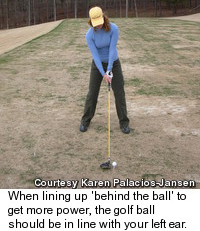
To hit the ball correctly in the sweet spot you must understand how the clubhead should approach the ball.
When you hit a driver, the angle of attack is shallow. The clubhead should arrive to the ball at the same level.
This sweeping motion assures that you will hit the ball in the sweet spot.
Set-up Correctly for Power and Distance
In order to achieve the correct angle, you must set-up "behind the ball at address." To do this, play the ball off the inside of the left foot and tilt slightly into your right side so that the head starts behind the driver. You want to have the ball in line with your left ear. This position will help you turn and sweep the ball off the tee at impact.
Try This Drill
Practice setting up behind the ball with the driver. Place a club behind your back and make sure that your right shoulder is lower than the left. This angle should set your head behind the ball at address. Practice making a level turn, at the top of your backswing and make sure your left shoulder is over your right knee. If your left shoulder is still over your left knee, then you have a reverse pivot.
Practice your driving set-up in the mirror. Check your alignment and make sure that you are set-up behind the ball at address. Your set-up should promote a sweeping motion.
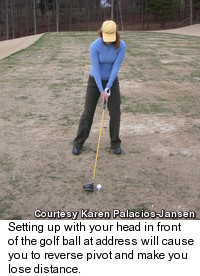
The most common fault I see with high handicappers is that they have the wrong angle of attack with their drivers. This happens when they set up incorrectly with too much weight on the left side, causing the head to be on top of the ball or even in front of the ball at address.
A reverse pivot follows this set up and causes too steep of an angle of attack. When the clubhead approaches too steeply or from the outside, you will end up hitting the ball on the toe or on the top of the clubhead.
Golf Tip: Get more power on your golf swing
Author: Karen AuthorPalacios-Jansen, voted one of America's Top 50 Instructors by Golf for Women magazine, is a LPGA Teaching Professional and an AFAA Certified Personal Trainer. She owns Swing Blade Inc., a golf events management company, and her golf-specific program Cardiogolf is available on DVD. Read her golf instruction blog at WorldGolf.com
Special to WorldGolf.com
You've heard that a golf-specific workout will help you get more distance, so you're pumping iron, jogging religiously, stretching - but you still haven't gained any distance off the tee. What's the deal?
Well, I will be the first to tell you that a golf-specific exercise program will help you gain distance, but you also need to have good swing technique to take advantage of your strength and flexibility.
If you are losing power in your golf swing, it may not be because you are not strong enough; there may be a flaw in your swing. You may need to examine your golf swing more carefully and figure out where the power leaks are occurring. I have assembled a list of seven factors that may be causing power loss, with tips on how to get more distance.
Seven reasons you're losing power
1. You may not be making solid contact with the sweet spot, or center of the clubface. For every quarter-inch you hit the ball outside of the sweet spot, you lose 12 yards of distance. If you hit the ball off the toe of the clubface, which is three-quarters of an inch outside the sweet spot, you'll lose 36 yards of distance.
Concentrate on hitting the ball on the sweet spot. Buy special clubface tape available at the pro shop that will mark your strike point when you make contact with the ball. Work until you can make solid contact with the ball right in the middle of the sweet spot.
2. You may be coming over the top on the downswing. Specifically, your arms are swung away from your body on the downswing, resulting in an "out to in" clubface path. This produces very weak shots. To fix this problem, concentrate on your right elbow (or left elbow if you are left-handed) on the downswing. Try this drill: Swing to the top of your swing and pump your arms down half way, so that your right elbow points away from your body. This will make your arms come closer to your side and make the clubhead stay behind your hands so that you can hit the inside of the ball for solid contact.
3. You may be turning your shoulder incorrectly on the downswing. If you throw your right shoulder (left shoulder if you are left-handed) toward the target as you start your downswing, the result is an over the top motion with the club. To fix this problem, concentrate on making your right shoulder rock down instead of out on the start of the downswing. This will help the arms stay closer to the body and initiate an "in to out" swing instead of over the top.
4. You may be hitting the outside of the ball at impact, imparting left to right spin. To correct this, you need to hit the inside of the ball at impact instead. To help you achieve this position, have the butt end of the club pointing inside the ball-target line as you swing your arms down. This will help you hit the inside of the ball.
5. You may be initiating your downswing with your upper body instead of your lower body from the top of the swing. This will cause your arms to swing away from your body, creating a power loss. To correct this, you must initiate the downswing with your lower body first and let the upper body follow to the finish. Concentrate on leading your downswing with your legs instead of your upper body.
6. You may be making contact with the ball at the wrong point. If your clubhead makes contact with the ground before the ball, you will lose power and hit the ball fat or thin. To make correct contact, play the ball farther back in your stance. This will help you achieve a downward blow and give you more power. Usually the ball is placed in the middle of the stance for a mid iron, but to improve contact at impact, move the ball back of center. This will help you make better contact. As you gain confidence, you can move the ball back to the center of your stance.
7. You may be pushing the ball down the fairway with your arms instead of swinging the clubhead. If your left or lead arm looks like a chicken wing on the follow-through, the club is cutting across the ball, resulting in a power loss.
To adjust, you'll need to release your forearms. Try the split grip drill to get the proper feeling. Without a ball, slide your right hand down until your index finger is on the shaft. This will make your right arm longer on the club. Take practice swings and you will feel how the right arm folds over the left one on the follow-through. Practice this until it becomes automatic and then practice hitting shots with your regular grip.
Are we Swingers or Hitters?
It's a good question and there is a difference in these two golf moves.
However, one should always 'SWING the CLUBHEAD' up and down through the ball along the target line to the pin.
In reality, all good ball strikers are 'SWINGING HITTERS'.
For right-handers, comfortably using a golf club, the sensation should be Swinging the clubhead from the left target shoulder (the pivot point) which will contribute to travelling down the line. So the longish left arm swings tha club while, approaching the bottom of the swing arc, the right hand put on the hit.
Each hands job is different. The target left hand controls the clubface. The brace-side right hand takes the lag out of the club shaft or clubhead. It makes the bottom hit.
We hear about body parts in golf. Which does what and when? What leads and what follows? What rests and what works.? I think golf is a co-operative balance of everything from the toe-nails to the finger-nails. It is a progressive muscular action from the brace foot or 'GROUND UP' through the body and club shaft to the ball resulting in holing it!
How Many Swings Should We Have In Your Bag?
From a pure teaching/mechanical standpoint you might be surprised at the answer, which is .....TWO.
How do we come to this position? Keeping it as simple as we can.
The two swings are:
1) The FULL SWING ...where we go from the bottom (address position) to the TOP of our comfortable range and back to the bottom where we make IMPACT. Solid , magical results always...RIGHT?
2) The LESS THAN FULL SWING...where we do not get to our comfortable top of the swing. This is an abbreviated swing and we use them often.
So TWO swings with fourteen or more clubs. This includes your putter which makes less than a full swing.
To ensure clarity, once our bag is calibrated (In other words, we know exactly how far each club goes), we should generally make all full swings until the yardage is shorter than our full swing pitching or sand wedge. From this distance in we then adjust with less than full swings.
Golf Clubs - Parts and Features
Golf Clubs are the most essential piece of equipment in the game of Golf. Golf Clubs are used in making the Golf Swing which hopefully results in the Golf Ball flying towards the hole.
Here are the different parts of a golf club, its features and the uses of each part:
Golf Club Grip
Golf Club Parts The Golf Club Grip is the top part of the Golf Club where we place our hands and Grip the Golf Club. These are the Kinds of Grip Golf Clubs might have:
1. Natural Leather Grips. Grips that are made of natural leather are the most expensive and are less water resistant. These Club Grips are also easy on the hands.
2. Synthetic Leather Grips. Are less expensive than those made with natural leather, but with almost the same features. Synthetic leather Grips are less durable than Rubber Grips.
3. Rubber Grips. Grips made of rubber are the cheapest and most durable Golf Club Grips. Rubber Grips are highly water resistant and are easiest to install.
4. Cord Grips. Cord Grips have rough surface and provides Firmer Grasp through rain, sweat or snow. You need tough hands for this Type of Grip.
Golf Club Shaft
The Golf Club Shaft is the middle part of the Golf Club that connects the Grip to the Club Head. Most Golf Club Shafts are made out of steel or graphite. The longer the Golf Club Shaft, the farther the distance that can be reached with the Golf Club. For more information reach our section on choosing the correct Shaft Size. 
The Golf Club Head is the bottom part of the Golf Club. The Clubhead is the Part of the Golf Club that actually hits the ball and they come in various shapes and sizes that all have a great effect on the Golf Ball Flight. Most Golf Clubheads are made from wood, steel or titanium. A Golf Clubhead consists of the following parts:
a. Clubface.
The Clubface is the area that hits the ball. Hitting the Ball with other parts aside from the face makes your ball go to a different direction and not towards your target. An example of this is the Shank or hitting your ball with the side of the club thus making the Ball Fly in almost a right angle.
b. Toe and Heel.
The Heel is the part of the Clubhead that is attached to the Shaft. The other end of your Clubhead is called the Toe.
c. Sole.
This is the Part of the Clubhead that rests on the ground. The Sole is designed depending on the use of your Club. The Driver's Sole is broad and flat making it glide on the ground.
d. Grooves.
The Clubface has a set of horizontal Grooves that helps in putting spin on the ball. Spin makes the ball fly higher and roll less when it lands.
e. Hosel.
The Hosel is the hole or opening where the Shaft connects to the Clubhead.
Golf Club Features
A golf club can have many features and characteristics that influence your Golf Shot in terms of the spin and the flight of your ball. The spin and the flight are important considerations in choosing the Clubs you should use in a particular situation. Each Club is made with different degrees of Loft and different Grooves.
1. Grooves.
As explained, the Grooves on the Clubface creates a backspin. These Grooves promotes ball flight and lessens the roll.
2. Loft.
The Loft is the degree that the Clubface is tilted away from the center of the Shaft. The higher the Loft your club has, the higher you can get your ball up in the air and the shorter the distance. Long shafted clubs with a bit of Loft makes a long, low shot with a bit of roll. Higher Loft means your club will make your ball fly high and land without rolling very much.
3. Weight.
The weight of your golf club will depend on its overall size and the materials used. Some people prefer heavier golf clubs as it gives them more a better feeling of control. Others prefer lighter clubs to make powerfull swings less cumbersome. Heavier clubs do help in making a harder impact on the golf ball. Club Weight depends on your own personal preferences.
4. Length.
The weight length of your Golf Club differs per club and is also dependant on your own length. Read our section on Golf Club Sizing for more information on choosing a correct club size.
A Golf Club might look like a simple instrument but it is a highly technical piece of Equipment. Understanding the Different Parts of the Golf Club is the first step to better understand Golf Clubs and selecting the correct one.
How To Choose The golf clubs
According to the golf game's rules a player cannot carry more than fourteen clubs during a game. Thus, most of today's players do not carry more than this maximum permitted number.
There four basic types of golf clubs: Woods, Irons, Wedges, and Putters.
Woods are usually used to hit long golf shots. Standard woods that are carried in a golf bag are 1, 3, and 5 Woods. A 1 Wood is typically referred to as a ‘driver’. As the number of your wood increases (2, 3, 4, 5, 6, 7, 8, 9) you lose the amount of distance it can go, but you gain a higher trajectory. Recent golf club technology has made higher lofted woods for shorter distances. A standard golfer's bag will have a driver (1 wood) and a couple of fairway woods (3- and/or 5-wood). A driver is the longest club (typically 45 inches) making it the toughest to handle during a swing.
Iron clubs are mostly used for shots that are expected to go an average distance - typically from 125 to 200 yards. The lower the number iron, the less degree on the face of the club, hence, the farther the distance the ball will travel. On the other hand, the higher the number iron, the higher the degree on the face, and consequently, the loftier the shot will be.
An Iron features a thin clubhead with grooves on it. Experienced players opt for a blade style iron, while beginners get a cavity-back style. A blade-style has a clubhead with a full back, but a cavity back's clubhead is hollow. It is hollowed out to make a perimeter weighting effect helpful for less-experienced golfers.
Irons are categorized as long (1, 2, 3,4), mid- (5,6,7) and short (8,9). Short irons are the easiest to hit while the long ones are the hardest. The shorter the iron, the more loft there is and for beginners, the more loft, the better.
The most popular irons used are 3 Irons and 9 Irons, however, many companies also manufacture 1 Irons as well as 10 Irons.
Wedges are used for semi-short shots. They are also used for chipping, and sand shots. There are several types of Wedges, including sand wedges, pitching wedges, and lob wedges. These are iron clubs and are used for games played on difficult grounds, and approach shots to the green.
A putter is a golf club that has a low loft. This enables the ball to roll farther. A putter is typically shorter than all of your other golf clubs. Putters are the clubs most regularly used in the game and come in clubhead styles of blade, heel-toe and mallet. Lengths come in belly putters, standard and broomstick (long) putters. Which selection to choose will be based on an individual preference.
Another popular type of golf club nowadays is the Hybrid club. The Hybrid club is a cross between the Iron and the Wood, and is made for people who have difficulty using these other types of clubs.
The physical capability of every golfer is different - stance, posture, size, swing characteristics etc – yet golf manufacturers make golf clubs identical as an off-the-shelf product. However with a custom fit golf club in your hands you can be safe in the knowledge that your clubs are personalized for you and be sure that when you make a good swing the club will be square at impact and your shot should soar down the middle of the fairway.
The majority of golf clubs which you can purchase today can be customized to accommodate the individual differences between golfers. The lie angle/loft, type of shaft, length of shaft, grip type and grip size can be modified. All that is required to custom fit these clubs is some simple measurements and a basic analysis of your swing.
The following information is usually all that is required: gender, height, distance from the wrist to the floor, age, handicap/skill Level, and swing speed.
Gender is utilised as the golf industry in general utilises different definitions as to what the standard length is for both a male and a female.
Height and distance from wrist to floor is used jointly so that the fitter can determine the length of club which is best suited for you. For example a tall man with long arms could easily be fitted with a shorter shaft than an average height male with short arms. The majority of golfers however use standard length clubs.
The remainder of the measurements are used to determine what type of flex the shaft on your club should have.
The notion that the more costly the club the better it is purely doesn't hold water anymore. If you do enough research and read reviews you'll find a club that matches your degree of interest. Some play for a weekend activity and there are others who'd like to move up in the rankings. If the occasional pastime is your stride, a low- to mid-performance club can work for you. But those of you who intend to play more regularly should seriously consider custom, higher-performance clubs.
By Paul Buntrage
Published: 11/8/2006
Golf Grip Tips
Golf Grip Tips - The legendary golfer Ben Hogan summed it up perfectly when he said - "A player with a bad golf grip doesn't want a good swing" Here's how to form the perfect golf grip 1. Hold the top of the golf club with your right hand. Important Golf Grip Tip - For the perfect golf grip let your left-hand hang naturally from the shoulder with your hand down the side of the golf club grip. The left hand will actually turn slightly inwards, towards the body, this is ok - golfer Nick Faldo recommends this golf grip tip for forming the perfect golf grip.
2. Bring the left hand forward from its NATURAL hanging position and place it against the golf club grip. The shaft should run from the fleshy pad in your palm down DIAGONALLY downwards. It should run approxiamately 1/4 inch (6mm)from the base of your little finger down through the middle joint of your index finger. 3. Now close the fingers of your left hand to form the perfect golf grip. *Important Golf Grip Tip - Do NOT grip the club too tightly. The perfect grip pressure has been likened to holding a tube of toothpaste - tight enough to hold it, but not so tight that you would squeeze out the paste.
 4. Your thumb should be on top of the grip, just a little to the right of center as you look down on it. Important Golf Grip Tip - do not push the left thumb too far down the grip of the club. It may give the feeling of a more solid hold on the club, but in fact has the opposite effect, as it prevents the thumb properly supporting the golf club at the top of the backswing.
 5. Now bring your right hand from its natural position, and lay the club into the fingers. Your right thumb and index finger should form a kind of trigger around the grip. To form the perfect golf grip, rest the little finger of your right hand into the groove formed by the first and second fingers of the left hand. *Important Golf Grip Tip - have the feeling that the palm of your right hand mirrors the angle of the golf club face. To really ingrain the correct golf grip it is sensible to purchase a practice club like the Refiner Swing Trainerthat has a pre-molded grip that positions your hands into the perfect golf grip. Regular practice with such a club will help you to be very comfortable with your golf grip.
Grips with success

Stroke Solutions Inc., a small golf equipment company in Grafton, had a huge role in K.J. Choi's victory at the AT&T National on Sunday.
Choi installed an over-sized SuperStroke grip on his putter and went on to win the inaugural event at Congressional Country Club in Bethesda, Md.
He finished second in the field in putts per green in regulation (1.685) and fifth in total putts (115).
Choi bought the SuperStroke after seeing it advertised in an infomercial.
"He just sat on it for a while," said Ron Creten, president of Stroke Solutions. "He said it was big and ugly and he didn't know if he wanted to put it in play.
"His agent called us Friday and said K.J. was like a kid in a candy store, he was so happy."
At about 1½ inches in diameter, SuperStroke is twice the size of a conventional putter grip. The mass helps reduce two of the biggest causes of missed putts: Too much grip pressure and too much wrist action. SuperStroke can be installed on any putter.
"When you watch infomercials, half the time you don't believe it, half the time you believe it and you don't know what's right," Choi said after his second victory of the year. "But I just kept on watching it and I was convinced that it might work for me. So I ordered one."
Creten said several PGA Tour players had practiced with the grip but none had used it in a tournament.
Since Choi's nationally televised victory, however, the company Web site ( www.superstrokegrip.com) has been deluged.
"Response has been off the charts," Creten said.
Callaway Golf ordered a dozen grips and plans to ship them to Scotland for its staff members who are playing in the British Open next week. Edwin Watts will begin selling the grips and Creten is negotiating with Golf Galaxy.
SuperStroke was invented by Harold Roelke of Elm Grove. He called the grip "Fatso" and it was named best new product at the PGA Merchandise Show. But he had problems marketing the grip, eventually ran out of money and sold his company to Creten, Keith Miller and majority owner Chris Doerr.
"We had a family reunion in Alaska and I didn't see any part of the tournament," said Roelke, a minority partner in Stroke Solutions. "As my wife said, even if nothing else happens from this point forward, I invented something that helped somebody win a PGA Tour event."
Make More Birdies
By MICHAEL CORCORAN
Deputy Editor, GOLF MAGAZINE
Despite making the Ryder Cup team, at the end of 2006 I wasn't happy with my game. To make sure 2007 was a better season, I called a meeting at the TPC at Sawgrass with my teacher, Mike Bender, my mental coach, Morris Pickens, and my caddie, Damon Green. We identified three key areas to work on: birdie more par 5s, improve my overall iron play, and return my putting to the way it was when I was the No. 1 putter on the Nationwide Tour in 2003.
My improvement in these vital areas spurred my win at the Masters. The recipe for success was a lot of hard work (with Mike and his colleague Ty Krieger) and repetition of simple drills. Over the next five pages, I'll show you how you can get better just like I did.HOW TO BIRDIE MORE PAR 5s
Over four rounds at Augusta National, I birdied 11 of the 16 par 5s I played, and I laid up every time. I executed that strategy with confidence because I knew I could get the ball close to the hole with one of my two basic lob-wedge shots: (1) a low- to medium-height shot with maximum spin to attack middle and back pins, and (2) a high, soft ball to front hole locations.
SHOT 1: Low to medium-height spinner
Play it when the pin is middle or back
CHECKPOINT: How to find your lay-up distance
Lay up to a distance where you can make a controlled 3/4 swing. For me, that's 50-75 yards. To determine your distance, drop 10 balls at the 100-yard marker on a hole (when the course is empty) and make 3/4 swings with your favorite wedge. Take the average distance of the 10, and that's your lay-up distance.
SHOT 2: High, soft wedge shot
Play it when you can't get spin (that is, from the rough) to front pins and to super-firm greens that won't hold.
CHECKPOINT: How to find your lay-up distance
Lay up to a distance where you can make a controlled 3/4 swing. For me, that's 50-75 yards. To determine your distance, drop 10 balls at the 100-yard marker on a hole (when the course is empty) and make 3/4 swings with your favorite wedge. Take the average distance of the 10, and that's your lay-up distance.
Tiger Wood Golf Techniques

Tiger Woods made a big splash on the golf scene when he first appeared and in the years since then, golfers around the world have been trying to emulate him. Tiger Woods golf techniques are becoming more and more popular as newcomers try to learn from the master. From the incredible swing to the stance, people are obsessed with the techniques of Tiger Woods golf.
You can begin learning Tiger Woods golf techniques by simply watching the pro. There are videos available with him playing a basic round of golf and just watching him play is an ideal way to pick up on slight moves and swings. If necessary, you can even pause the tape and move it frame by frame to see exactly how this champion golfer does his thing.
Not so interested in learning Tiger Woods golf techniques from watching him play? Not a problem! There are also special training videos and DVD's available designed to teach you his specific moves. These will run you a bit more than just watching the game on TV, but it is worth it to have the techniques explained and demonstrated in plain English with slow motion when necessary. This is one of the better ways to learn Tiger Woods golf techniques.
Other methods of learning that amazing swing or stance are to hire a professional or to read a book. Believe it or not, there are golf coaches who specialize in Tiger Woods golf training! They will, for a fee, teach you exactly how he does it, get you standing the same way and have your swing greatly improved, just by using Tiger Woods golf techniques. The real life, hands on approach is far better than just watching a video for many golfers, but it will also cost you a lot more. However, many people feel that it is worth the extra cash to learn to improve your game!
While not as popular an option, you can also find the Tiger Woods golf techniques outlined in books. Not many people can learn by simply reading, but for those who prefer to pick up their knowledge in books, the diagrams and written explanations are a far cheaper method of learning. Your local library will no doubt stock a few books on golf techniques.
Tiger Woods golf is an important method of playing these days, now that he is so famous. Without Tiger Woods, many young people these days would not be playing, assuming that golf is an old person’s game. But every generation can benefit from his techniques and should make an effort to study them.
Golf Tournament
Looking for tips on planning a charity golf tournament? There are many factors to consider, so I'll stick to the four main ones for this article. The success of your charity golf event revolves around maximizing player turnout, increasing pledge sizes, obtaining sponsored prizes, and planning tips.
Player Turnout
Your success depends on how many players your golf event draws and how actively you have your players solicit sponsors for their own rounds.
To maximize turnout, you need to get major publicity for your event. That means putting out multiple press releases, getting local media coverage from newspapers and television stations, and placing ads in the sports section of the local paper.
For the best results, put your press releases out through PR Web. Appoint a spokesperson to handle all media contacts and follow-up. For more tips, read my article on fundraising publicity.
Charity Pledges
The key is getting each player to collect a certain amount of pledges. I recommend a minimum of $100 per player in pledges. I've also played in tournaments where that number was $250 per player.
Obviously, you want to motivate the participants to raise as much money as possible. Some groups offer incentives for the top pledge getters. Others seek corporate sponsorships for that firm's players.
Pledge amounts determine the success of your charity golf event, so get input from experienced golfers and golf pros in your area.
Top Golfer Prizes
Generally speaking, you'll draw more golfers if you have great prizes for longest drive, closest to the hole, hole in one, lowest team score, lowest actual score, and best adjusted score (handicap).
You solicit local merchants to sponsor those prizes. Work with an insurance-related prize company for things like the hole-in-one contest. That way you can offer a bigger prize for a much lower outlay.
Aim to get 100 golfers (25 foursomes) and your small group could easily raise $10,000 or more. Larger turnouts will net even more with some charity golf tournaments drawing 500 golfers competing for big prizes.
Plan Ahead
Obviously, bigger pledges, more golfers, corporate sponsorships combined with massive publicity will work wonders for the bottom line of your charity golf tournament. With the right combination of these factors and good advance planning, you can certainly raise $75,000 or more for a charitable cause.
Contact local courses for group rates. Be sure to mention that you are planning a charity event and ask for discounts on cart and greens fees. Once you decide on your preferred location, reserve the date and tee times well in advance.
Charity Golf Event - Final Tips
Plan ahead to maximize the success of your charity golf event. For best results, pick a weekday when courses and large blocks of tee times will be easier to reserve. You'll often get the best rates by going to the course in person and talking to the pro or pro shop manager.
Corporate sponsors are another good way to go. Get some celebrities to golf with corporate bigwigs and you can easily raise $100k-$150k. Of course, convincing celebrities to donate their time takes some doing, but it's well worth it.
If it's your first golf tournament, be open to suggestions from other golfers. Consider working with a fundraising consultant who specializes in organizing charity golf tournaments. They work for a percentage of the gross, but you usually end up raising more funds due to their experience and sponsor contacts.
Greg reynolds writes about planning a charity golf tournament and other non-profit fundraisers at FundraiserHelp.com. Browse the site today for hundreds of great fundraising tiips.
Golf Success

1. Always use same swing pose every time you shift the ball from sand bunker.
Every time you have to shift the ball from the sand bunker, always use same swing pose, then adjust only the position of the ball, and also consider to adjust the weight of down swing whether it should be harder or lighter, in order to estimate the distance to the target. Unless you are in the really difficult situation such as the ball sinks into the sand , or in any circumstances that normal approaches could not be applied, then will use special techniques. Normally, the factor use to decide how deep the sand you should dig into is depends on individual experience in sand bunker shifting, but the basic approach is addressing openly , keep the putter floating a bit above the sand, then swing down to the same line where you are addressing. It is also useful to keep in mind that you should hit the ball on the left and slices from outside reach in and the power must come from the upper part of the body while your feet buried into the sand and do not be afraid to hit the sand.
2. Your swing must be smooth and continuous.
There are so many people who see a friend can drive far more than oneself , then try to follow his approach by trying to use as much power as they can , as a result , they won't be able to control the ball's direction. The one of important thing for golfer is to maintain equilibrium between the body and the swing and keep it stable. Up swing with gentleness , not fast and jerk, then transfer the weight to right leg, when down swing, transfer the weight down to your hip while your eyes still watch at the ball , and hit the ball to the desired direction. The most important thing is you must maintain your position the speed of the swing at the same level every time.
3. When shifting...the head must be still.
One important cause that affect to the changing direction of the ball is tottering head when shifting , which will change the balance of your body. Therefore, to do effective shifting you must keep your head still and stable throughout the process. the basic approach when doing shift is stand open, lay the ball close to the right leg, maintain the weight to the left leg, hold the grip in short figure and do the stroke like when you are putting. About which size of putter should be used is really depends on individual experience and expertise. You should get much training enough to decide which size of putter suit you the most.
4. When up swing, make sure that your left shoulder aligned with the right foot.
Address in correct posture when up swing will bring the most effective and powerful to the hit. You must always remember that when up swing turn left shoulder to align with the right leg. This pose will draw the power from muscles between the shoulder and the waist while full speed of the swing being generated. The enough and proper training will develop you swing very quickly.
5. Find the focal point where the putter hit the ball.
The technique that many pros use to find the proper focus to hit the ball is to keep putter a bit away from the ball and leave the small gap between the ball and the putter. This gap will allow you to know where the putter will hit the ball, as a result, you can decide the right focus.
Golf for beginner tips-part 2
By Declan Tobin
A good golfer is a golfer who is happy with their own game and willing to listen to advice from experience. A good temperament is needed to play golf, expect bad days it happens everyone from low handicappers to full professionals. Having a hot head will only cause you more problems.It can be daunting when starting as there is so much to remember but take time to practice and go to the driving range to help improve teeing off. Looking around the golf course you will see some players and think "Will I ever get to that level"? Remember everybody is different and we are not all made to be professionals, you should go out to do your best and bring in the best possible score and most of all, take home the enjoyment of the day.Teeing Off:How many times have we seen the big hitters hit the ball out of sight, if you are thinking that way starting, think again. You should be thinking of placement and keeping the ball in play.
Hitting the ball a long way is one think, keeping it in play and well placed for the next shot is the way to think. The driver can be a difficult club to use of the tee when starting but practice will make it easier. If you are using the oversized drivers like most are remember to tee the ball up higher than normal to avoid knocking the ball down. If you find the 3 or 5 wood easier to hit then hit that until your game improves. On a par 4 or 5 many people hit a low iron from the tee.
Whatever you are comfortable with, use.A good swing:In golf timing is everything. By swinging faster and harder you will not hit the ball any further, and most possibly will end up hitting a horrible shot anyway. A slow backswing and a good steady hit will make all the difference, rushing in golf gets you nowhere. Keep a steady head and do not raise it too quickly to see where the ball has gone, if you do you may find yourself going hard right if you are using right hand clubs and vice versa if using left handed clubs. Feet position is important; align your feet correctly to avoid an unwanted right to left or left to right shot.Clubbing from the fairway:If you find that you are looking from the fairway to the green you need to choose your next club carefully, under clubbing will leave you short and possible in the bunker or water hazard, over clubbing will leave you long and possibly in similar danger.
Overtime you will become aware of all the clubs in your bag and the distance you can hit each one comfortably. You find yourself between clubs, meaning the next shot for example is neither an 8 or 9 iron. In a case like this do not hit the 9iron and try to force the shot, hit the 8 and go slightly down the shaft allowing you total control over the shot.Good Golf Gear and Clubs:Like in most cases it depends on the budget you have. Golf clubs can range from a couple of hundred dollars to thousands. Are you brand orientated? As a keen golfer myself and off a handicap of four I play most of my golf in Ireland and in the US and from my travels I have seen beginners in both countries spending obscene money starting.
We all want the best but the clubs will not do the work for you. You are not going to notice exceptional back spin or side spin starting so start with a sensible budget and build from there. It's you who needs the practice to improve the overall play. Clubs worth $3,000 dollars will not help you starting anymore than clubs worth $400. If you have extra cash to spend put it into golf shoes or waterproof clothing or spend it on travelling to other golf courses to gain experience.Reducing handicaps:There is no magic stick here, practice is the only way to improve and by improving you will automatically reduce your handicap either by observation from the golfing committee you belong to or by winning a prise or two.
Listen to others and learn, you need to have an open mind playing golf and be willing to try new shots, different stances and even new equipment as time goes by.Like all you will reach your peak and the best you will get out of golf is the enjoyment of getting out but for the elite few that next level could be pro.

Golf for beginner tips-part 1
Almost anyone can learn to play an enjoyable game of golf, regardless of age or natural abilities. I have worked over the years with many golfers with Physical Disabilities. However many have not allowed this unfortunate handicap to limit them in continuing to enjoy golf. In fact, many are fundamentally better than their healthy counterparts because they are forced to utilize sound mechanics which prove that Golf can make the playing field more equal for everyone.
Through these articles you will see how I am going to dispel many myths that are prevalent in the world wide golfing community, such as "Keep your eye on the ball". I teach blind golfers to play, so that throws this theory out the window. Golf is a Billion Dollar Industry of Misinformation! I am not going to try to re-invent the wheel for you - only act as a guide to help you sort out fact versus fiction when it comes to what really goes on in the golf swing and the game. So if you want to learn to play golf, you CAN. Now let's move on to "lesson one", and how I approach golfers who are new to the sport.
My first lesson with a pupil: they show me, I show them.
Without showing or telling a new pupil anything at all, I have them swing the club the best they can. Then I briefly have them explain to me what they think it takes to hit the ball. This gives me an idea of what natural ability they possess, as well as how to approach them mentally based on their verbal descriptions.
After the new golfer has made some swings for me and we have talked briefly about whatever they have been exposed to up to this point in learning, I have them sit back and watch, and listen, as I fully explain and demonstrate the 5 basic body actions necessary to achieve maximum results in attaining their golfing goals of "playing well in a relatively short period of time which will require minimum amounts of maintenance".
The "5 Basic Actions" are:
1. Foot Action
2. Leg and Knee Action
3. Hip and Shoulder Action
4. Arm Action
5. Hand and Wrist Action
Other than your head, this incorporates your entire body. In the next lesson we will start the process of how to start your swing from the "Ground Up instead of the Hands Down" using this "5 basic actions dynamic domino effect" - which creates the proper chain reaction necessary to becoming a solid golfer for a lifetime
By Tom Ward, PGA Tour Instructor

The Perfect Swing
Most golf instructors, with few exceptions, will agree that the perfect golf swing is a myth. All you have to do is look at the variety of different swings on the PGA and LPGA tour each weekend on television. The swings may look different but they have some common elements. First, they all start with good basics: Grip, Aim and Setup. Most importantly, the swing repeats itself every time. There are players who have success on tour with funny looking swings. It is because the swings repeat each time from constant practice. Also, they have confidence that their swing will work.
The golf swing can be simple but is often complicated by too much thinking. A good golf swing starts with good rhythm. You can't make a good forward swing unless you take your time going back to set up proper rhythm and motion. A swing that is too fast back, usually has the club and body working against each other and helps create poor shots. The object of the golf swing is to create speed on the downswing - not the back swing. A fast backswing will create bad motion and a hands dominated swing that will be hard to repeat. Take the club away slow for better motion and rhythm. Because the backswing sets up the downswing, we will discuss it first.
A good backswing starts with the arms - not the hands. You don't want to pick the club up at takeaway. You want to draw it away in a one-piece motion. As the club starts back, the left shoulder and hips should turn naturally to allow weight to transfer to the right side. The hands should begin to set at waist high. As the club continues to the top, the shoulders should continue to turn. At the top it is important to have the hands set but not broken down. Overswinging at the top will create negative club speed and inconsistent swings.
Now that we've talked about the backswing, let's talk about the downswing. The object of the downswing is to return the clubhead to the ball with maximum controllable speed. Just as too fast of a backswing is no good, too hard of a downswing can also cause bad golf shots. There are many theories on what should start the downswing. I find that most players who think about pulling with their left arm from the top will create a more consistent swing with all body parts working together. Many players from watching the tour players tend to try to lead the downswing with the left side, and as a result slide ahead of the ball at impact causing weak slicing shots.
To complete the swing you must have a good finish. The finish in the golf swing, unlike in baseball, needs to be high, not left. We find most beginners find it more natural to finish low and left causing topped shots and difficult to get the ball airborne. The clubface needs to stay square for several inches after impact to create proper flight on the ball. Also, in the finish the weight that you transferred to the right side in the backswing now must transfer to the left side. With a good finish your right knee should face the target, right foot up so all spikes are visible, and hands high close to your left ear.
Article wrote by: By Thomas Tetrault, PGA Pro, Fall River Country Club.
Visit this site got more useful and nice article for you

Correcting Your Slicing the Ball
The most common explanation of a sliced shot (the ball curving too much from left to right) is that the ball is being struck from the outside to the inside of the target line. However, you can just as easily slice the ball from the inside to the
outside which could be worse as the ball starts to the right and then slices.
Most of the time the reason the ball slices is because there is no rotation or crossover (the left arm rotating with the right arm crossing the left throughout the hitting area). The pros have a tendency to hook more than slice because they all have a rotation in their swing. Left to right players (faders, which means slightly left to right) have to hold the rotation in the hitting area.
In order to develop a rotation in your swing you must go back to my fundamentals:
1. a good grip
2. keep your elbows together in the hitting area
3. keep the center (the upper front of your torso) moving
If you keep the elbows together in the hitting area and keep the center moving, the rotation will automatically happen. A bad grip ruins everything.
Golf Tips - Holding the Handle - The Three Primary Grips
Holding the Handle - The Three Primary Grips
Light Grip Pressure
The hands must work together as a single unit when striking a ball with power. There are three common and fundamentally sound grips from which to choose, which are pictured on the following pages.
In addition to the type of grip you choose, another characteristic of a sound grip is light grip pressure. Gripping the club too tight can cause thin, weak shots that slice. A lighter grip enhances wrist hinge - a vital power source in the swing. This light pressure also increases the amount of clubface rotation, thus improving your chance of squaring the club at impact.
On a scale of 1 to 10, where 1 is light and 10 is tight, I recommend a pressure of 4 or 5. This allows the club to be swung with power and control. At address, feel relaxed and tension-free in your hands and forearms.
Sam Snead said, "Hold the club as if you had a little baby bird in your hand." This pressure, combined with the proper placement of the hands on the handle, will give you your greatest chance to produce longer, straighter shots.

Hit List


